
SaaS Development Agency Pricing: What You're Actually Paying For
We charge EUR 60k for a full SaaS build. Here's the exact breakdown: what goes to design, engineering, infrastructure, and documentation - and what most agencies hide.

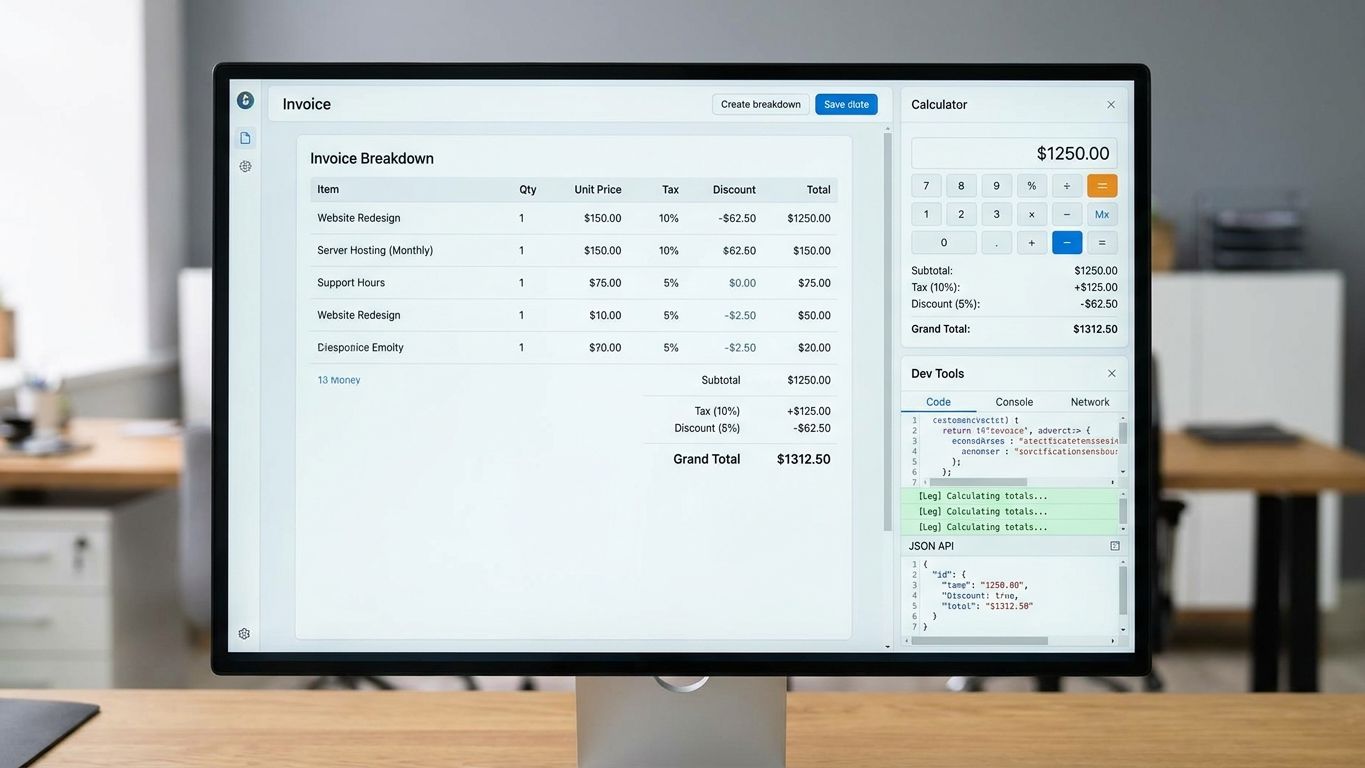
EUR 247 per hour. That's what a 50-person agency effectively charges when you divide their EUR 120k SaaS quote by actual engineering hours. We charge EUR 60k for the same scope. The difference isn't quality. It's overhead.
Most SaaS agency pricing pages show a range ("EUR 50k-200k") and a "contact us" button. That tells you nothing. You wouldn't buy a car if the sticker said "EUR 20k-80k, call for details." So here's our exact pricing breakdown for a full SaaS product build - what you pay for, what each phase costs, and where the money actually goes.
Key Takeaways > - Our EUR 60k SaaS build breaks down to roughly 40% engineering, 20% design, 15% infrastructure/DevOps, 15% documentation/handoff, and 10% project management. > - A typical 50-person agency charges EUR 120k+ for the same scope because 30-40% of their fee covers overhead you never see. > - The most expensive phase isn't development. It's the first 2 weeks of architecture and scoping.
The Full EUR 60k Breakdown
Here's where every euro goes in a 6-month SaaS product build. These are real numbers from our actual projects, averaged across Pushary, Morta CRM, and three other builds we've done in the past 18 months.
Phase 1: Discovery and Architecture (Weeks 1-2) - EUR 8,000
- Product requirements workshop: EUR 2,000 - Technical architecture design: EUR 3,000 - Database schema and API design: EUR 2,000 - Sprint planning and milestone definition: EUR 1,000
This is the most expensive phase per day. Two senior engineers spending 2 weeks making decisions that affect every line of code written afterward. We define the tech stack, map data models, design the API surface, and plan every sprint. Cutting corners here costs 3x more in rework later.
Phase 2: UI/UX Design (Weeks 2-4, overlapping with Phase 1) - EUR 12,000
- User flows and wireframes: EUR 3,000 - Visual design system: EUR 4,000 - Interactive prototypes: EUR 3,000 - Design QA and responsive specs: EUR 2,000
We design in 2-week cycles. Wireframes first to validate structure, then visual design on top. The design system (colors, typography, spacing, components) gets built once and reused across every screen. This is why our designs feel cohesive instead of like 15 different designers touched the project.
Phase 3: Core Engineering (Weeks 3-18) - EUR 24,000
- Authentication and user management: EUR 3,000 - Core feature development (4-6 features): EUR 12,000 - API development and integrations: EUR 4,000 - Database implementation and optimization: EUR 2,000 - Testing (unit, integration, E2E): EUR 3,000
This is the bulk of the work. 16 weeks of sprint-based development, shipping working software every 2 weeks. The EUR 12,000 for core features breaks down to roughly EUR 2,000-3,000 per major feature. A "feature" in our definition is something like "campaign builder with drag-and-drop" or "real-time dashboard with filtering" - not a button or a page.
Phase 4: Infrastructure and DevOps (Throughout) - EUR 9,000
- CI/CD pipeline setup: EUR 1,500 - Staging and production environments: EUR 2,000 - Monitoring and alerting: EUR 2,000 - Performance optimization: EUR 1,500 - Security hardening: EUR 2,000
Infrastructure work runs parallel to development. We set up CI/CD in week 1 so every sprint delivers to a staging environment. Monitoring goes in early so we catch performance issues during development, not after launch.
Phase 5: Documentation and Handoff (Weeks 16-24) - EUR 7,000
- Architecture documentation: EUR 2,000 - API documentation: EUR 1,500 - Deployment runbooks: EUR 1,000 - ADRs and decision records: EUR 1,000 - Handoff sessions and knowledge transfer: EUR 1,500
This is the phase most agencies skip or rush. We spend 15% of the budget on documentation because it's what determines whether your next developer can maintain the product or needs to reverse-engineer it. Read our harness engineering approach for the full breakdown.
Project Management and Communication (Throughout) - EUR 0 separately
We don't bill for project management as a line item. With a 2-person senior team, communication overhead is near zero. There's no project manager relaying messages between you and the developers. You talk directly to the people writing the code.
At larger agencies, project management eats 10-15% of the budget. On a EUR 120k project, that's EUR 12k-18k paying someone to schedule meetings and forward emails.
What a 50-Person Agency Charges (And Why)
A mid-size agency (30-50 people) quoting the same project would typically come in at EUR 100k-150k. Here's where the extra money goes:
Overhead (30-40% of the quote): Office space, management layers, HR, sales team commissions, marketing budget, tools and licenses. A 50-person agency in Berlin or Amsterdam has EUR 50k-80k/month in fixed costs before anyone writes code. That cost gets distributed across every project.
Coordination tax (10-15%): A junior developer builds the feature. A senior developer reviews it. A project manager tracks the status. A designer creates the mockup. A QA engineer tests it. Five people touching one feature means 5x the communication overhead. Meetings multiply. Standups, sprint reviews, retrospectives, design reviews, code reviews, client syncs - a 50-person agency might have 10-15 hours of meetings per week on your project.
Margin (20-30%): Agencies need higher margins than freelancers because they carry fixed costs. A 25% margin on a EUR 120k project is EUR 30k. On our EUR 60k project, our margin is smaller in absolute terms but similar in percentage because our costs are lower.
Here's the contrarian take: the 50-person agency isn't ripping you off. Their cost structure is genuinely higher. But you're paying for their overhead, not for better code. A junior developer at a big agency writes the same React component as our senior team - except our version ships faster because there's no approval chain.
What's NOT in the EUR 60k
Transparency means telling you what's excluded too.
Ongoing hosting costs: Vercel, AWS, or whatever infrastructure the product runs on. Budget EUR 50-500/month depending on scale. We set it up and hand off the accounts.
Third-party service costs: Stripe fees, SendGrid, Twilio, monitoring tools. These are your subscriptions, not our line items. We'll recommend the right tools and set them up, but the monthly bills are yours.
Content and copywriting: If your SaaS needs onboarding copy, help documentation, or marketing content, that's separate. We're engineers and designers, not copywriters.
Post-launch feature development: The EUR 60k covers the initial build and 30 days of support. New features after launch are scoped and quoted separately.
App store submission (if applicable): Apple and Google review processes add 1-2 weeks of back-and-forth. We handle the submission, but the timeline is outside our control.
How Our Pricing Compares
We've collected pricing data from 23 agencies in Europe and North America over the past 2 years (from client conversations - founders love telling you what other agencies quoted them). Here's the landscape:
- Offshore agencies (India, Eastern Europe): EUR 20k-40k. Lower cost, but you're typically working with junior developers, across a big timezone gap, with project managers as the interface. Quality varies wildly. - Mid-size European agencies: EUR 80k-150k. Solid work, but 30-40% of that goes to overhead. Build timelines of 6-9 months. - Premium US/UK agencies: EUR 150k-300k. Top-tier design and engineering, but you're paying for the brand name and the office in Shoreditch. - Us: EUR 60k. Senior-level work, 6-month timeline, complete documentation, fixed scope. No overhead because there's no office, no sales team, and no management layer.
The quality gap between a EUR 60k build from us and a EUR 120k build from a mid-size agency is negligible. We know this because we've rebuilt projects from both tiers. The gap between EUR 60k and EUR 25k, however, is significant. Below a certain price point, you're getting junior developers, no documentation, and code that needs to be rewritten within a year.
Why Fixed-Scope Pricing Changes Everything
Every number in this article is a fixed price. Not an estimate. Not a "starting at." Fixed.
Hourly billing creates a fundamental misalignment. The agency makes more money when the project takes longer. The client wants the project done faster. These incentives pull in opposite directions.
Fixed scope flips the incentive. We make more money when we ship efficiently. You pay the same whether it takes us 800 hours or 600 hours. So we're motivated to make smart architectural decisions that reduce complexity, not to pad timelines with unnecessary meetings and revision rounds.
The risk shifts to us, and that's fair. We've built enough SaaS products to scope accurately. If we underestimate, that's our problem. If the scope changes because you want new features mid-project, we re-scope and re-price. No surprises for either side.
When EUR 60k Is Too Much (Or Not Enough)
Spend less if: You're pre-revenue and testing an idea. Build a EUR 25k MVP with 3 core features. Validate with real users. Come back for the full build when you know what to build.
Spend EUR 60k if: You have a validated idea, funding or revenue, and need a production-ready product with proper architecture, testing, and documentation. This is the sweet spot for seed-stage startups and funded side projects.
Spend more if: You need enterprise compliance (HIPAA, SOC 2), complex integrations (10+ third-party APIs), or a platform with multiple user types and complex permissions. These push into EUR 80k-120k territory. We'll tell you during scoping if EUR 60k won't cover it.
Frequently Asked Questions
Why are you cheaper than other agencies with similar quality?
Two senior engineers doing the work, no office, no management layer, no sales team. Our fixed costs are under EUR 5k/month. A 50-person agency's fixed costs are EUR 50k-80k/month. That difference goes directly into the price gap. We're not cheaper because we cut corners. We're cheaper because we don't have overhead.
Can you break the EUR 60k into milestone payments?
Yes. We structure payments across project milestones: 30% at kickoff, 30% at mid-point, 30% at delivery, and 10% after the 30-day support period. Each payment is tied to a specific deliverable, not a calendar date. If we're behind schedule, we don't invoice until the milestone is met.
What happens if the project costs more than EUR 60k?
It doesn't. Fixed scope means fixed price. If we underestimated, we absorb the difference. The only scenario where the price changes is if you request features that weren't in the original scope. In that case, we scope and price the addition separately before building it. You approve every euro before we spend it.
Do you offer ongoing retainer pricing after launch?
Yes. Post-launch retainers start at EUR 3k/month for maintenance, bug fixes, and small improvements. Larger feature development gets scoped as separate projects. Most clients use the retainer for 3-6 months after launch and then either bring development in-house or come back for a discrete phase-two project.
*Want a fixed-scope quote for your SaaS? Book a 30-minute call and we'll give you a detailed breakdown within 48 hours. Or see our SaaS Product Build service to understand the full scope of what's included.*
Related serviceSaaS Product Build
Notes on building fast.
One short email a month from the RalphNex team. Projects we shipped, ideas we tested, and what worked.
No spam. Unsubscribe anytime.

Aadil Ghani
Founder & CEO
Co-founder and managing director of RalphNex. Started coding at 14. Writes about building fast and the projects we ship.
More from the RalphNex Journal
How We Set Up CI/CD for Every Client Project
Every project we ship gets the same CI/CD pipeline. It takes 4 hours to set up and saves 200+ hours over the project lifetime.

SaaS Development for Edtech: Building for Schools and Students
Schools buy software in June, onboard in August, and complain in September. Your edtech product needs to survive all three.