
0 to 2,000 Users: How We Grew Automaticall with Marketplace Partnerships
2,000 users. Zero ad spend. Automaticall grew entirely through marketplace partnerships and integration listings. Here's the full playbook.

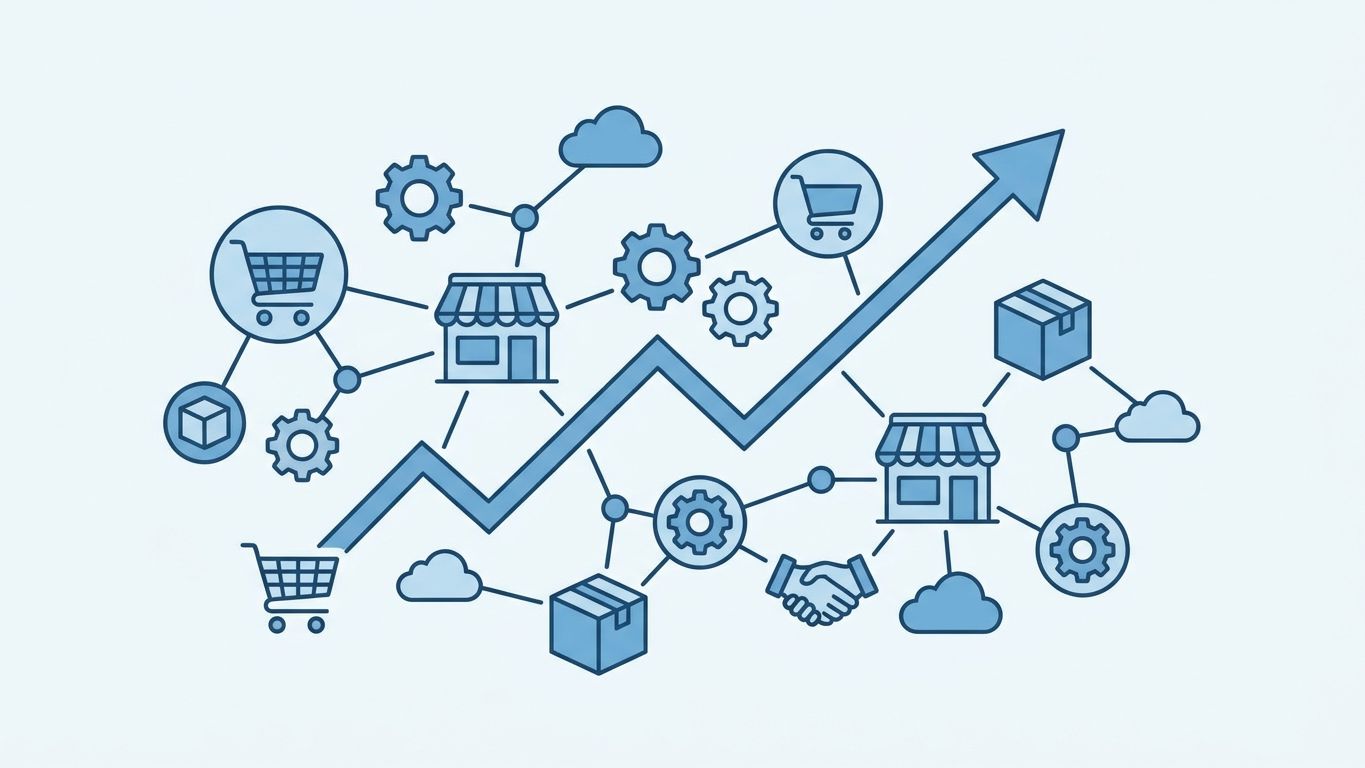
2,000 users and EUR 0 in ad spend. That's Automaticall's growth story. No Facebook ads, no Google Ads, no influencer campaigns, no content marketing budget. Just marketplace partnerships and integration listings on platforms where our target users already lived.
Most SaaS growth advice assumes you'll spend money on acquisition. "Run paid ads to validate demand." "Invest in content marketing." "Hire a growth marketer." All reasonable strategies. But for a product like Automaticall - an AI-powered phone call assistant - the fastest path to users wasn't advertising. It was being present in the places where business owners already shopped for tools.
Here's the full playbook, including what worked, what didn't, and the numbers behind each channel.
Key Takeaways > - Marketplace listings (app stores, integration directories, tool aggregators) can drive consistent, free acquisition if your product fits a category buyers actively search. > - Partnership growth compounds. Each new integration listing drives users who then use Automaticall with another tool, creating organic demand for the next integration. > - Paid ads would have been faster for the first 100 users. But marketplace growth is more sustainable and has a lower CAC (customer acquisition cost) long-term.
What Automaticall Does (Context for the Growth Strategy)
Automaticall is an AI phone assistant. It answers calls, handles common queries, takes messages, books appointments, and routes complex calls to humans. Target users: small businesses (dental offices, law firms, real estate agencies, service companies) that miss calls because they're too busy to answer.
This context matters for the growth strategy because Automaticall's value is tied to other tools. A dentist using Automaticall also uses a scheduling tool, a CRM, and a phone system. Being integrated with those tools - and listed in their marketplaces - puts Automaticall in front of exactly the right audience.
Channel 1: Integration Marketplace Listings
The single biggest growth driver. We built integrations with tools our target users already used, then listed Automaticall in each tool's marketplace or integration directory.
How it works: Most SaaS products have an integration marketplace (Zapier, HubSpot, Calendly, etc.). When a small business owner searches for "AI phone assistant" or "call answering" in their existing tool's marketplace, they find Automaticall. The trust transfer is immediate - if it's in their tool's marketplace, it must be compatible and vetted.
Numbers: Marketplace listings generated roughly 45% of Automaticall's first 2,000 users. The conversion rate from marketplace listing view to signup was 8-12%, compared to 2-3% from cold traffic to our website. Users who found us through marketplace listings had 30% higher retention at 90 days.
What we listed on: - Zapier (largest impact - thousands of businesses search for phone/call integrations monthly) - Calendly's integration directory (direct fit: calls come in, appointments get booked) - HubSpot's App Marketplace (CRM users who want calls logged automatically) - Industry-specific tool directories for dental, legal, and real estate software
Effort required: Each integration took 1-2 weeks to build. The marketplace listing (screenshots, description, setup guide) took 2-3 days per platform. Some marketplaces have review processes that add 1-4 weeks. Total investment: roughly 2 months of engineering and writing time across all listings.
The compounding effect: Here's what made marketplace growth special. User A finds Automaticall on Zapier and connects it to their Calendly. Now Automaticall works with Calendly, and Calendly users can see the integration. User B finds us through Calendly and connects to their HubSpot. Each integration creates a path to the next user base. We didn't plan this - it emerged naturally from building good integrations.
Channel 2: Partner Referrals
Once we had integrations, the partner companies themselves became a referral channel.
How it works: When a Calendly user asks Calendly support "how do I handle phone bookings?", the support team recommends Automaticall because we're an integration partner. When a dental software company's sales team pitches their product, they mention Automaticall as part of the ecosystem. These aren't formal referral agreements with commission structures. They're organic recommendations that happen because the integration exists.
Numbers: Partner referrals accounted for roughly 25% of users. These were the highest-quality users - they came pre-qualified by a trusted source, had clear use cases, and converted to paid at 2x the rate of marketplace-acquired users.
How we built these relationships: 1. Built a genuinely good integration (not a half-baked connection) 2. Wrote comprehensive setup documentation with screenshots 3. Provided partner support teams with a one-page brief about Automaticall (what it does, who it's for, how it connects) 4. Responded quickly when partner support teams escalated integration questions
No business development team. No partnership managers. Just good integrations and good documentation. Partners recommended us because it made their product more valuable, not because we paid them to.
Channel 3: SEO Through Integration Pages
Every integration we built got its own landing page on the Automaticall website. "Automaticall + Calendly." "Automaticall + HubSpot." "AI phone assistant for dentists." These pages ranked for long-tail search terms that had low competition but high intent.
Numbers: Integration landing pages drove roughly 20% of signups. The traffic was modest (200-500 visits/month per page) but the conversion rate was high (5-8%) because visitors searching "AI phone assistant Calendly integration" have very specific intent.
Why it works: Nobody is writing content optimized for "[your product] + [partner product]" combinations. The search volume per page is low (50-200 searches/month), but across 15 integration pages, it adds up to 1,000-3,000 qualified visits per month with almost no competition.
Effort required: Each landing page took 2-3 hours to write and design. We built a template that dynamically pulled integration details and reused it across all partner pages. After the template was built, adding a new page was 1 hour of work.
Channel 4: Community and Word of Mouth
The remaining 10% of growth came from organic word of mouth. Small business owners talk to each other. A dentist who stopped missing calls told their dentist friend. A real estate agent who booked more viewings shared it with their office.
We didn't engineer virality. The product solved a painful, visible problem - missed phone calls. When someone's phone stops ringing unanswered, the people around them notice and ask what changed.
What we did do: make the product easy to explain. "It answers your phone calls with AI." Seven words. No jargon. No explanation of the technology. Small business owners could recommend Automaticall in a 10-second conversation because the value proposition was instantly clear.
What Didn't Work
Not everything was a win. Here's what we tried and abandoned.
Cold outreach to small businesses. We emailed 500 dental offices offering a free trial. 3 responded. Small business owners get 50 cold emails a day from SaaS products. The noise is too high for cold outreach to work at the scale we needed.
Social media content. We posted on LinkedIn and Twitter for 2 months. Generated followers and engagement but almost zero signups. Our target users (small business owners) aren't on LinkedIn evaluating SaaS tools. They're in their clinics, offices, and job sites. The audience mismatch was fundamental.
Product Hunt launch. We launched on Product Hunt and got 150 upvotes and 40 signups. Of those 40, 3 converted to paid users. Product Hunt's audience is tech enthusiasts and founders, not dental office managers. Good for developer tools and consumer apps. Wrong audience for B2SMB (business-to-small-and-medium-business).
Free trial with credit card required. We initially required a credit card for the free trial. Signup rate was 60% lower than without the card requirement. Small business owners don't enter credit card details for tools they're evaluating. We removed the requirement and signups tripled.
The Economics: Why No Paid Ads?
At some point, every growth conversation turns to paid acquisition. Why not run Google Ads for "AI phone assistant" and accelerate growth?
We considered it. Here's why we chose not to, at least for the first 2,000 users.
CAC comparison: - Google Ads for "AI phone assistant": estimated EUR 15-25 per click, EUR 150-250 per trial signup, EUR 400-600 per paying customer - Marketplace acquisition: EUR 0 per user (development cost amortized across all future users) - Partner referrals: EUR 0 per user (documentation cost amortized) - SEO integration pages: EUR 0 per user (content creation cost amortized)
The breakeven on each marketplace integration was roughly 50 users. After that, every user is effectively free. Paid ads never get cheaper - you pay for every click, forever.
The sustainability argument: If we'd spent EUR 50k on Google Ads, we'd have 2,000 users faster. Maybe 3 months instead of 8 months. But the moment we stop spending, the user flow stops. Marketplace listings and partner referrals continue generating users whether we're actively working on them or not. Eight months after building our Zapier integration, it still generates 30-50 signups per month with zero ongoing effort.
Our contrarian take: paid ads are a crutch that most early-stage SaaS products reach for because they're fast and measurable. But they train you to think of growth as a spending problem instead of a distribution problem. If your product integrates with tools your users already use, marketplace distribution is slower to start but fundamentally more sustainable than buying clicks.
The Playbook for Your SaaS
If your product connects to other tools (and most SaaS does), here's how to replicate this:
Step 1: Identify your users' existing tools. Talk to your first 10-20 users. What tools do they use daily? Look for patterns. If 8 out of 10 use Calendly, that's your first integration.
Step 2: Build 3-5 integrations in order of user overlap. Start with the tools your users already use. Build genuine, useful integrations - not superficial connections that check a box but don't add value.
Step 3: List in every marketplace that accepts you. Write compelling descriptions. Take good screenshots. Write setup documentation that makes the integration effortless. Marketplaces surface well-documented integrations higher.
Step 4: Build integration landing pages on your site. One page per integration. Target "[your product] + [partner product]" and "[partner product] phone integration" keywords. These pages convert at 3-5x the rate of your homepage because visitors have specific intent.
Step 5: Nurture partner relationships. Send integration usage metrics to your partner contacts. Show them how many of their users are benefiting. This motivates partners to promote the integration in their own channels.
Step 6: Add paid ads after marketplace distribution is established. Once you have organic growth as a baseline, paid ads become a multiplier rather than a dependency. The math changes when you're adding fuel to an engine that already runs versus trying to start a cold engine with money.
Frequently Asked Questions
How long does marketplace growth take to show results?
Expect 2-3 months before meaningful user flow begins. The first month is building integrations and getting marketplace listings approved. The second month is optimization (improving descriptions, adding screenshots, collecting reviews). By month 3, consistent signups should appear. Automaticall's marketplace growth accelerated after month 4 as multiple listings created compounding network effects.
Does this strategy work for all SaaS products?
It works best for products that integrate with other tools (CRMs, scheduling tools, communication platforms). If your product is standalone with no natural integration points, marketplace distribution won't fit. It also works better for B2B/B2SMB products than consumer products because business tool marketplaces have higher purchase intent than consumer app stores.
How many integrations do you need to start seeing growth?
Three to five quality integrations covering your users' most common tools. Each integration should be genuinely useful, well-documented, and listed in the partner's marketplace. Breadth without depth (20 shallow integrations) works worse than depth without breadth (5 excellent integrations). Build fewer, build them well.
Should I skip paid ads entirely?
Not necessarily. Paid ads are useful for testing messaging, validating demand quickly, and accelerating growth after you have organic distribution working. We chose to skip ads for Automaticall's first 2,000 users because marketplace distribution was more sustainable and cost-effective. If you need to validate demand in 2 weeks instead of 2 months, paid ads serve that purpose.
Notes on building fast.
One short email a month from the RalphNex team. Projects we shipped, ideas we tested, and what worked.
No spam. Unsubscribe anytime.

Aadil Ghani
Founder & CEO
Co-founder and managing director of RalphNex. Started coding at 14. Writes about building fast and the projects we ship.
More from the RalphNex Journal
How We Set Up CI/CD for Every Client Project
Every project we ship gets the same CI/CD pipeline. It takes 4 hours to set up and saves 200+ hours over the project lifetime.

SaaS Development for Edtech: Building for Schools and Students
Schools buy software in June, onboard in August, and complain in September. Your edtech product needs to survive all three.