
Shipping Speed as Competitive Advantage: Why Velocity Beats Perfection
Pushary: 30 days. Shamaze: 2 months. CryptoTicker's site: 48 hours and 1.6M impressions. Perfection is the enemy of revenue.


30 days from kickoff to production for Pushary. 2 months for Shamaze on iOS and Android. 48 hours for CryptoTicker's site that hit 1.6 million impressions in month one. 3 months for Morta, a full real estate CRM. Every project we've shipped reinforces the same lesson: the team that ships first learns first, and the team that learns first wins.
Speed isn't a tactic for us. It's the core thesis that everything else is built around. Our pricing is fixed-scope because hourly billing incentivizes slow delivery. Our team is small because coordination overhead kills velocity. Our tech stack is boring because chasing frameworks wastes weeks. Every decision we make runs through a single filter: does this help us ship faster?
This article is the argument for speed as a durable competitive advantage, backed by real numbers from real projects.
Key Takeaways > - Speed compounds. Shipping 2x faster doesn't just save time - it doubles your learning cycles. > - Perfection at the MVP stage destroys more startups than bad code. > - Our fastest project (CryptoTicker, 48 hours) outperformed our longest project in month-one results.
The Compounding Effect of Speed
Speed in software development isn't linear. It compounds. And most people underestimate compounding.
A team that ships in 30 days gets user feedback on day 31. By day 60, they've shipped v2 based on real data. By day 90, they're on v3 with a product shaped by 2 months of user behavior.
A team that ships in 90 days gets user feedback on day 91. By day 120, they've identified what needs to change. By day 150, v2 ships. They're 60 days behind the fast team, and the gap is widening because the fast team has 4 more iterations of user data informing their decisions.
After 12 months, the fast team has shipped 8-10 iterations. The slow team has shipped 3-4. The fast team's product is shaped by 10 months of user feedback. The slow team's product is shaped by 6 months of user feedback. That 4-month difference in real-world learning is the actual competitive advantage, and it grows every month.
We've seen this play out with Pushary. Shipping in 30 days meant we had paying users in week 5. Their feedback shaped every subsequent sprint. Features we assumed were critical turned out to be irrelevant. Features we thought were "v3 material" became urgent after users asked for them repeatedly. None of that learning would have happened if we'd spent 3 months building v1.
Why Perfection Kills Startups
Here's our most contrarian position: perfection at the MVP stage is destructive. Not just wasteful - actively harmful.
The perfection trap works like this:
A founder has a vision. They want the product to match that vision before anyone sees it. So they spend extra weeks polishing the UI, adding edge case handling, optimizing performance, and building features that "complete" the experience. By the time they launch, they've spent 2-3x the original budget and 2-3x the original timeline.
Then users arrive and ignore half the features. They use the product differently than expected. The carefully polished onboarding flow is skipped. The performance optimization was premature because the bottleneck is in a different part of the system. The edge case handling covers scenarios that never occur.
All that perfection work was wasted. Not because it was bad engineering, but because it was aimed at the wrong target. The right target only becomes visible after real users interact with the product.
The numbers from our projects:
Pushary launched with a basic UI. No dark mode. No custom theming. No animated transitions. Time saved: approximately 2 weeks. Post-launch, users told us they wanted better notification previews and campaign duplication. Neither was on our original polish list. We built both in week 3 based on real demand.
CryptoTicker launched as a marketing site in 48 hours. It wasn't pixel-perfect. Some interactions were slightly rough. It hit 1.6 million impressions in month one. Not a single user complained about the rough edges. They complained about the content cadence (they wanted more). We knew exactly what to improve because we shipped fast enough to get feedback while the audience was still paying attention.
Shamaze (iOS + Android bedtime stories for kids) shipped in 2 months. The initial version had 20 stories. Parents wanted more stories, not better animations or fancier UI. If we'd spent an extra month perfecting the UI, we'd have learned the same thing but a month later and EUR 15k poorer.
How We Engineer for Speed
Speed isn't about cutting corners. It's about eliminating waste. Here's how we systematically remove everything that slows delivery without reducing quality.
1. Fixed tech stack. No deliberation.
Every project gets Next.js, TypeScript, PostgreSQL, Tailwind CSS, and Vercel. We don't evaluate frameworks. We don't debate ORMs. We don't "explore" new tools during client projects. Our stack is chosen because we can ship with it in our sleep.
New framework evaluation happens on our own time, not during a client engagement. This saves 1-2 weeks per project that would otherwise be spent researching and onboarding to new tools.
2. Component library from previous projects.
We maintain a library of production-tested components: authentication flows, billing integration, dashboard layouts, form patterns, table views, modal systems. Not a design system. A component library built from things we've actually shipped.
Starting a new project means copying proven patterns, not building from scratch. The auth setup for Pushary was adapted from a previous project in 4 hours. A from-scratch implementation would have taken 3 days.
3. Fixed-scope sprints with no renegotiation.
The scope is agreed before development starts. During development, it doesn't change. If the founder has a new idea mid-sprint, it goes on the "next sprint" list. This eliminates the context switching and re-prioritization that kills velocity.
We've tracked the impact: projects with zero scope changes during sprints ship 25-30% faster than projects with "minor" mid-sprint additions. The additions aren't the problem. The decision-making process around additions is the problem. Every scope discussion is 1-2 hours of non-engineering time that multiplies across the team.
4. Two-person core team.
Aadil and Dash. Both coding since 14. No project managers. No design committee. No approval chains. One person reviews the other's work. Decisions happen in minutes, not days.
The overhead of coordination scales exponentially with team size. A 2-person team has 1 communication pathway. A 5-person team has 10. A 10-person team has 45. We stay small so communication overhead stays near zero.
We bring in specialist contractors when needed (3D animation, native iOS performance, specific domain expertise), but the core decision-making stays between two people who trust each other's judgment completely.
5. Deployment from day one.
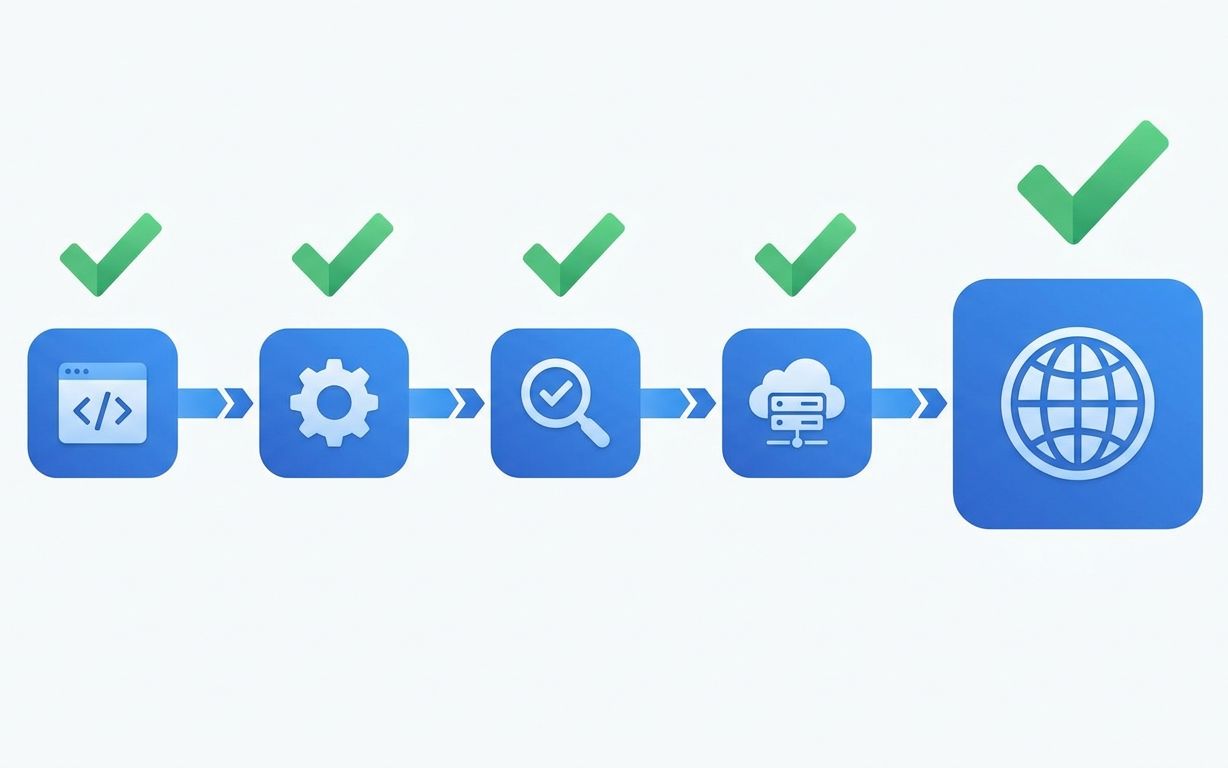
The CI/CD pipeline goes live before the first feature is built. Preview deploys for every PR. Automated testing on every push. Production deployment on every merge. This means the product is always in a deployable state. There's never a "deployment sprint" or a "release preparation week." Shipping is continuous.
Real Project Timelines
Here's how speed manifested across our recent projects:
Pushary (push notification SaaS) - 30 days - Day 1-3: Scoping, architecture design, project setup - Day 4-10: Authentication, billing, core notification engine - Day 11-20: Campaign builder, automated flows, analytics - Day 21-25: Testing, polish, documentation - Day 26-30: Production deployment, monitoring, handoff - Result: Production SaaS with paying users by day 42
Shamaze (iOS + Android) - 2 months - Week 1-2: Design, native app scaffolding - Week 3-5: Core features (story engine, audio playback, parental controls) - Week 6-7: Testing on devices, App Store/Play Store submission - Week 8: Launch, monitoring, first feedback cycle - Result: Both app stores, live users, active feedback loop
CryptoTicker (marketing site) - 48 hours - Hour 0-8: Design and content strategy - Hour 8-24: Build, responsive layout, animations - Hour 24-40: Content population, SEO setup, analytics - Hour 40-48: QA, deployment, launch - Result: 1.6 million impressions in month one
Morta CRM - 3 months - 12 two-week sprints - Working software delivered every sprint - Client could have stopped after sprint 4 with a usable product - Result: Full real estate CRM with 200+ custom fields, pipeline management, and reporting
Automaticall - 4 months - Voice AI product built to 2,000 active users - Sprint-based delivery with continuous user feedback - Each sprint added features based on what the previous sprint's users requested
ProxControl - 1 month - Deep-tech engineering: velocity drift measurement for industrial spray-paint systems - 2 algorithm phases for signal processing accuracy - Domain-specific challenge, not a standard SaaS build
The common thread: fixed timelines, aggressive scope control, continuous delivery. No project drifted from its original timeline by more than 1 week.
The Speed vs Quality False Dichotomy
"But if you ship fast, the code quality suffers."
No. Fast delivery with bad code is hacking. Fast delivery with good code is engineering discipline. They are not the same thing.
Our code quality is consistent across all projects regardless of timeline. Why? Because quality comes from practices, not time. Automated testing, type safety, code review, CI/CD, and documented architecture don't slow you down. They speed you up by preventing the debugging sessions and production incidents that actually kill velocity.
The projects that take the longest aren't the highest quality. They're the ones with the most scope, the most deliberation, and the most rework from building without user feedback. The fastest projects have the tightest scope, the quickest decisions, and the least wasted effort.
We've measured defect rates across projects of varying timelines. There's no correlation between development speed and bug count. There IS a correlation between scope clarity and bug count. Clear scope produces fewer bugs regardless of timeline. Unclear scope produces more bugs regardless of how much time you spend.
What Speed Actually Costs
Speed requires investment upfront. The reason most teams are slow isn't lack of talent - it's lack of infrastructure for speed.
Investments we've made: - Component library (80+ hours to build, saves 20+ hours per project) - CI/CD template (4 hours to set up per project, saves 200+ hours per project lifecycle) - Documentation templates (pre-built architecture doc templates, API doc generators) - Deployment automation (zero-touch production deployment from day one) - Decision frameworks (pre-made decisions for common technical choices)
These investments have a payoff period of roughly 2 projects. After that, every project benefits from the accumulated infrastructure. The gap between teams that invest in speed infrastructure and teams that don't widens with every project.
Speed Applied to Client Engagements
Speed isn't just about our internal practices. It's about how we structure client engagements for velocity.
Pre-development: 1-2 days for scoping, not 2 weeks. We've scoped enough projects that pattern matching is fast. A SaaS product with auth, billing, and a core feature loop takes 3-6 months. We don't need a 40-page requirements document to know that.
Decision-making: Clients get Slack/Discord access to the team. Questions get answered in hours, not days. Design approvals happen in real-time during sprint reviews, not in a 2-week approval cycle. The single biggest velocity gain in most projects is reducing decision latency.
Feedback loops: Every two weeks, the client sees working software. Not wireframes. Not mockups. Working software on a preview URL. They click through it, find issues, suggest changes, and we incorporate feedback in the next sprint. This prevents the "I expected something different" conversation that derails projects after months of building.
Handoff: Documentation is written during development, not after. By the time the project ends, the docs are complete because they were part of each sprint's deliverables. No 3-week "documentation phase" at the end.
When Speed Isn't the Answer
We're honest about the limits of the speed thesis. Some projects genuinely require slower, more deliberate development:
- Regulated industries with compliance requirements. HIPAA, PCI-DSS, and SOC 2 compliance can't be rushed. Security audits take 2-3 weeks regardless of your engineering speed. - Novel algorithms and research-heavy products. If you're inventing new approaches to a technical problem, the exploration time can't be compressed. ProxControl's velocity drift algorithms required iterative testing that doesn't parallelize. - Hardware-dependent products. Physical prototyping, manufacturing timelines, and supply chain logistics have fixed durations.
For everything else - SaaS products, mobile apps, marketing sites, marketplaces, internal tools - speed is the correct default. Ship fast. Learn from users. Iterate based on data. The market rewards velocity over perfection every single time.
Frequently Asked Questions
How do you ship so fast without sacrificing quality?
Speed comes from eliminating waste, not cutting corners. Fixed tech stack (no framework deliberation), reusable component library (no building from scratch), CI/CD from day one (no manual deployment), and aggressive scope control (no building features users didn't ask for). Quality practices like automated testing and code review are non-negotiable regardless of timeline.
Is 30 days realistic for a SaaS MVP?
Yes, with extreme scope discipline. Pushary shipped in 30 days with 4 core features: campaigns, flows, analytics, and billing. A 30-day timeline requires a 2-person senior team, a proven tech stack, and a founder who is decisive about scope. Most MVPs take 2-3 months, which is also fast if the scope is controlled.
What if my product needs more than 3-5 features to be viable?
Question that assumption. List every feature you think is necessary, then ask: "Would a user pay for this product without this specific feature?" If yes, it's not necessary for v1. Most products need fewer features than their founders think. The ones that genuinely need 15+ features at launch are complex enterprise products, not MVPs.
How do you handle scope changes during a project?
We don't. Scope is fixed before development starts. New ideas go on the "next sprint" list and are evaluated after the current scope ships. Mid-sprint scope changes are the #1 velocity killer across all projects we've seen. The discipline of "no, that's v2" saves more time than any engineering optimization.
Notes on building fast.
One short email a month from the RalphNex team. Projects we shipped, ideas we tested, and what worked.
No spam. Unsubscribe anytime.

Aadil Ghani
Founder & CEO
Co-founder and managing director of RalphNex. Started coding at 14. Writes about building fast and the projects we ship.
More from the RalphNex Journal
How We Set Up CI/CD for Every Client Project
Every project we ship gets the same CI/CD pipeline. It takes 4 hours to set up and saves 200+ hours over the project lifetime.

SaaS Development for Edtech: Building for Schools and Students
Schools buy software in June, onboard in August, and complain in September. Your edtech product needs to survive all three.