
React Native vs Flutter vs Native: A Pragmatic Comparison for 2026
We've shipped apps in React Native, Flutter, and SwiftUI. Here's which one we pick for each project type and why the internet debates are useless.

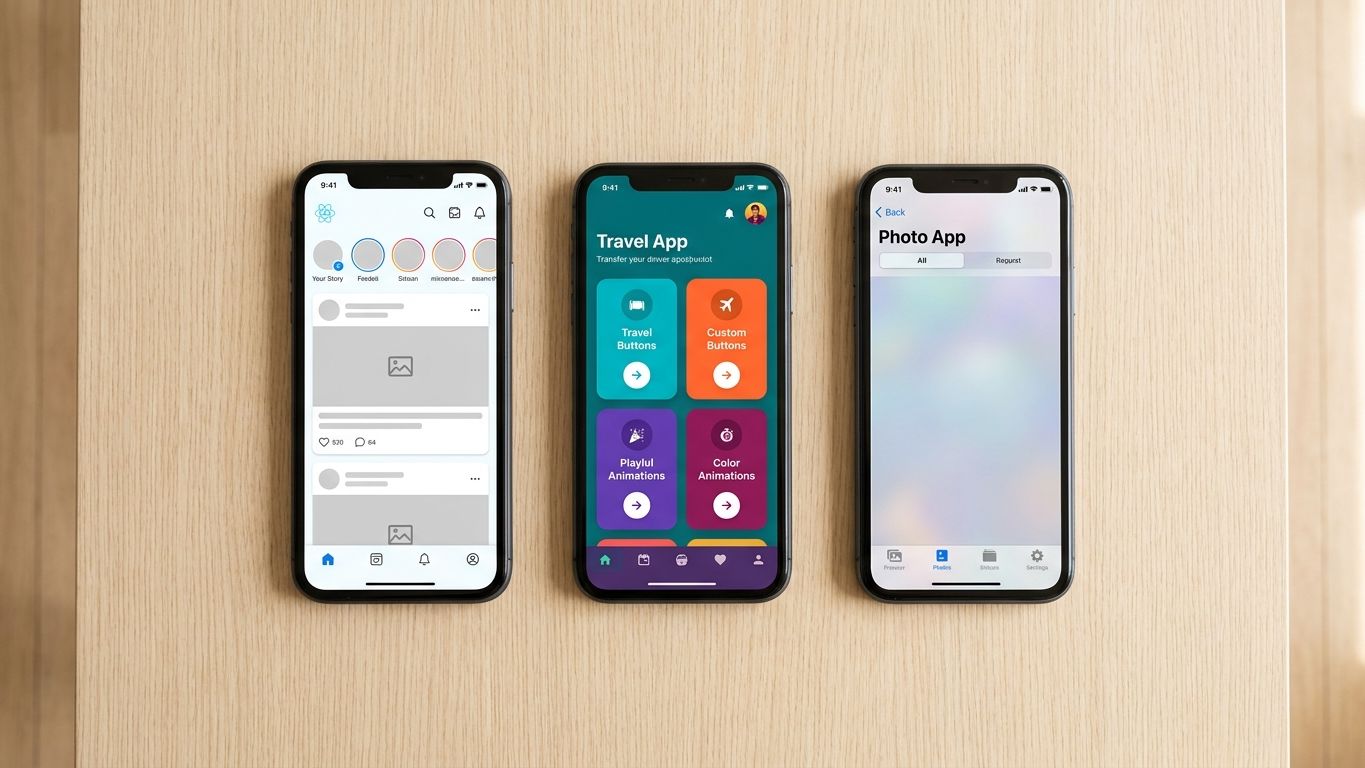
6 months ago we shipped Shamaze in React Native. iOS and Android, 2 months, EUR 30k. If we'd built it native, it would have been 4 months and EUR 55k for the same features.
That math makes React Native sound like the obvious choice. It's not. The framework decision depends on exactly 4 factors, and most comparison articles ignore all of them.
Key Takeaways > - React Native wins for content-driven apps and apps with web counterparts. Flutter wins for animation-heavy apps. Native wins for hardware-intensive apps. > - Cross-platform saves 30-40% on initial build. The savings shrink over time as platform-specific work accumulates. > - The best framework is the one your maintenance team already knows.
The Decision Matrix
Skip the theory. Here's how we decide.
| Factor | React Native | Flutter | Native (Swift/Kotlin) | |---|---|---|---| | Time to market | Fastest (shared codebase + web) | Fast (shared codebase) | Slowest (2 codebases) | | Initial cost | EUR 25k-35k | EUR 25k-35k | EUR 45k-70k | | UI fidelity | Good (native components) | Great (pixel-perfect custom UI) | Perfect (actual native UI) | | Performance | Good for 95% of apps | Good for 95% of apps | Best (no bridge/engine overhead) | | Hardware access | Good (mature plugin ecosystem) | Good (growing plugin ecosystem) | Full access | | Team availability | Largest talent pool | Growing talent pool | Moderate talent pool | | Long-term maintenance | Moderate | Moderate | Higher (2 codebases) |
If your app is a content-driven product - social, e-commerce, news, productivity - cross-platform wins. If your app relies heavily on device hardware - cameras, Bluetooth, sensors, AR - native wins. That covers 90% of decisions.
React Native in 2026: Where We Are
React Native has changed more in the last 2 years than in the previous 5. The New Architecture (Fabric renderer, TurboModules) is now the default. The bridge is gone. Performance is measurably closer to native.
What we like: - Shared code with web via React Native Web. Shamaze shares 70% of its business logic with the web dashboard. - The JavaScript/TypeScript ecosystem. npm has a package for everything. React Native has a mature plugin for almost everything. - Expo has matured into a legitimate production tool. EAS Build handles the App Store and Play Store deployment nightmare. - Hot reloading is still the best developer experience in mobile.
What still frustrates us: - Navigation libraries change every 18 months. We've migrated from React Navigation 5 to 6 to 7 in 3 years. Each migration is 2-3 days of work. - Native module compatibility breaks across React Native versions. Upgrading React Native from 0.74 to 0.76 broke 3 native modules on a recent project. - Android performance with complex lists and animations still trails iOS slightly.
Best for: Content-driven apps, apps that need a web counterpart, teams with React/TypeScript experience, projects under EUR 40k.
Flutter in 2026: Where We Are
Flutter's Impeller rendering engine shipped as default on both iOS and Android in late 2025. The jank that plagued early Flutter apps is mostly gone.
What we like: - Pixel-perfect UI consistency across platforms. Every pixel is rendered by Flutter's engine, not the platform. If you need identical UI on iOS and Android, Flutter delivers. - Dart is a better language than JavaScript for large applications. Null safety, strong typing, and a standard library that covers most needs. - The widget composition model is elegant. Building custom UI in Flutter feels more natural than in React Native. - Hot reload is fast and reliable.
What still frustrates us: - The web target is still not production-ready for content-heavy apps. SEO is poor. Initial load times are high. If you need a web version, you'll build it separately. - The plugin ecosystem is smaller than React Native's. Some niche native integrations don't have Flutter plugins. - Hiring Dart developers is harder than hiring TypeScript developers. The talent pool is real but smaller. - State management ecosystem has too many options and no clear winner (Riverpod, Bloc, Provider, GetX).
Best for: Animation-heavy apps, apps requiring pixel-perfect custom UI, teams that value UI consistency over platform conventions, projects where web is not a priority.
Native Development in 2026: When It Still Wins
The cross-platform frameworks have gotten good enough that native development is no longer the default recommendation. But there are still clear cases where native is the right call.
SwiftUI + Kotlin Multiplatform (our native stack)
SwiftUI has matured significantly. The gaps that made UIKit necessary for complex UIs have largely been filled. Kotlin Multiplatform lets you share business logic between iOS and Android while keeping native UI on both platforms.
When native wins: - Hardware-intensive apps. Camera processing, Bluetooth LE, NFC, ARKit/ARCore. The abstraction layer in cross-platform frameworks adds latency and complexity that hardware-intensive apps can't afford. - Platform-specific experiences. If your iOS app should feel like an iOS app (gestures, navigation patterns, design language) and your Android app should feel like an Android app, native delivers this without fighting the framework. - Long-term products with dedicated teams. If you're building a product that will be maintained by separate iOS and Android teams for 5+ years, native makes sense. The teams can move independently without being coupled by a shared framework. - Performance-critical paths. Real-time audio/video processing, games, and apps where every millisecond of latency matters.
When native loses: - Budget under EUR 50k. Building two native apps costs 60-80% more than one cross-platform app. - Time to market matters more than polish. Cross-platform ships one codebase in the time native ships half of one. - Your team is JavaScript/TypeScript-based. Don't hire Swift and Kotlin developers just for one app.
The Contrarian Take: Framework Choice Matters Less Than You Think
Here's what most comparison articles won't tell you: the framework accounts for maybe 15% of your project's success or failure. The other 85% is product decisions, team quality, and execution speed.
We've seen terrible apps built in SwiftUI and excellent apps built in React Native. The Shamaze bedtime stories app doesn't need native performance. It plays audio, shows illustrations, and handles subscriptions. React Native handles all of this perfectly.
We've also seen Flutter apps that should have been native. One client came to us with a Flutter app that needed real-time Bluetooth communication with industrial sensors. The Flutter Bluetooth plugin couldn't handle the throughput. They rewrote the Bluetooth layer in native code and bridged it back to Flutter. At that point, the "cross-platform advantage" was mostly gone.
The framework is a tool. Pick the right tool for the job, not the tool with the most GitHub stars.
Cost Comparison: Real Numbers
Based on our project data, here's what the same app costs across frameworks.
Simple content app (social feed, profiles, messaging): - React Native: EUR 25k-35k, 2-3 months - Flutter: EUR 25k-35k, 2-3 months - Native (iOS + Android): EUR 45k-60k, 3-4 months
Mid-complexity app (e-commerce, real-time features, payments): - React Native: EUR 40k-60k, 3-4 months - Flutter: EUR 40k-60k, 3-4 months - Native (iOS + Android): EUR 70k-100k, 5-6 months
Hardware-intensive app (camera, Bluetooth, sensors): - React Native: EUR 50k-80k, 4-5 months (includes native module work) - Flutter: EUR 50k-80k, 4-5 months (includes platform channel work) - Native (iOS + Android): EUR 60k-90k, 4-5 months
Notice that the cost gap shrinks for hardware-intensive apps. That's because you end up writing native code anyway for the hardware layer. The cross-platform framework only saves you on the UI and business logic, which is a smaller percentage of the total work.
Our Decision Process for Client Projects
When a client asks us to build a mobile app, we run through this checklist:
1. Does the app need a web version? Yes -> React Native (React Native Web shares code). This was the deciding factor for Shamaze.
2. Is custom animation central to the experience? Yes -> Flutter. Its rendering engine handles complex animations better than React Native's.
3. Does the app heavily use device hardware? Yes -> Native. Don't fight the abstraction.
4. What does the maintenance team know? TypeScript -> React Native. Dart -> Flutter. Swift/Kotlin -> Native.
5. Is the budget under EUR 40k? Yes -> Cross-platform (React Native or Flutter). You can't afford two native codebases.
We've used this checklist on every mobile project for 2 years. It's never led us to the wrong framework.
What About Kotlin Multiplatform?
Kotlin Multiplatform (KMP) deserves a mention. It lets you share business logic in Kotlin across iOS and Android while keeping native UI on both platforms.
We like the concept but don't use it for client projects yet. The ecosystem is still maturing. The iOS developer experience with KMP is acceptable but not smooth. And hiring developers who know both Kotlin and KMP's iOS interop layer is harder than hiring React Native or Flutter developers.
Check back in 2027. KMP might be our recommendation for teams with Kotlin experience by then.
Frequently Asked Questions
Should I use React Native or Flutter for my startup's MVP?
If your team knows TypeScript or you need a web version, React Native. If you want pixel-perfect custom UI or your team knows Dart, Flutter. For an MVP under EUR 40k, both will get you to market at roughly the same speed and cost. The bigger risk is picking a framework nobody on your future team knows.
Is native development dead in 2026?
No. Native development is still the best choice for hardware-intensive apps, platform-specific experiences, and long-lived products with dedicated platform teams. What's changed is that native is no longer the default. Cross-platform is the default, and native is the exception for specific use cases.
How much more does native cost compared to cross-platform?
Roughly 60-80% more for the initial build. A EUR 30k React Native app would cost EUR 50k-55k as two native apps. The gap narrows over time because platform-specific bugs and features accumulate in cross-platform codebases, requiring native-level work anyway.
Can I switch frameworks later if I pick the wrong one?
Technically yes, practically it's expensive. A full rewrite from Flutter to React Native (or vice versa) costs about 60-70% of the original build. It's not catastrophic, but it's not free. This is why the initial decision matters. Spend a day on the decision to save months later.
Notes on building fast.
One short email a month from the RalphNex team. Projects we shipped, ideas we tested, and what worked.
No spam. Unsubscribe anytime.

Dash Santosh
Founding Engineer
Co-founder and engineer at RalphNex. Been coding since 14, shipping fast since.
More from the RalphNex Journal
How We Set Up CI/CD for Every Client Project
Every project we ship gets the same CI/CD pipeline. It takes 4 hours to set up and saves 200+ hours over the project lifetime.

SaaS Development for Edtech: Building for Schools and Students
Schools buy software in June, onboard in August, and complain in September. Your edtech product needs to survive all three.