
Fixed-Scope vs Time and Materials: Which Pricing Model Works for Startups
Hourly billing incentivizes slow work. Fixed scope incentivizes efficient delivery. We've used both models. Here's why we only offer one now.


EUR 187,000. That's what a founder told us they paid a time-and-materials agency for a product that should have cost EUR 60k. The agency billed 1,870 hours at EUR 100/hour over 11 months. The product launched 5 months late with half the planned features.
Nobody was lying or cheating. The incentive structure just worked exactly as designed. The agency got paid more when the project took longer. The project took longer.
We use fixed-scope pricing for every engagement. Not because we're generous. Because it aligns our incentives with our clients' goals: ship fast, ship well, move on. Here's the full comparison so you can decide which model fits your situation.
Key Takeaways > - Time and materials (hourly billing) incentivizes agencies to spend more time. Fixed scope incentivizes efficient delivery. > - Fixed scope works best for projects with definable outcomes and bounded timelines (most MVPs and v1 products). > - Time and materials works best for ongoing maintenance, R&D with uncertain scope, and long-term team augmentation.
How Each Model Actually Works
Time and Materials (T&M)
You pay for hours worked. The agency tracks time, usually weekly, and invoices based on actual hours. Rates range from EUR 80-200/hour depending on seniority and location. The scope is flexible - you can change direction, add features, or pivot without renegotiating a contract.
The promise: you only pay for work done. The reality: you have no idea what the final cost will be, the agency has no incentive to ship faster, and "work done" includes time spent in meetings about the work, time spent reworking decisions that changed, and time spent by junior developers learning things senior developers already know.
Fixed Scope (Fixed Price)
You pay a predetermined amount for a defined set of deliverables. The scope is documented before development starts. The price doesn't change regardless of how many hours the agency spends. If they finish early, they keep the margin. If they go over, they absorb the cost.
The promise: you know exactly what you'll pay. The reality: the agency is motivated to ship efficiently because their profit depends on it. The tradeoff is less flexibility - adding features mid-project requires a change order with a new price.
The Incentive Problem with Hourly Billing
This is the part most agencies won't say out loud: hourly billing creates a financial incentive to work slowly.
We're not saying agencies deliberately stall. Most don't. But the incentive structure creates subtle behaviors that extend timelines:
More meetings than necessary. Every meeting is billable. A 30-minute standup with 4 team members is 2 billable hours. Multiply that by daily standups, weekly planning, biweekly retrospectives, and ad-hoc calls. We've seen agency timesheets where 25-30% of billed hours were meetings.
Junior developers learning on your project. A T&M agency has no reason to avoid putting a junior developer on a task that takes them 3x longer than a senior. They bill 24 hours at EUR 100/hour. A senior would have done it in 8 hours at EUR 150/hour. You pay EUR 2,400 instead of EUR 1,200.
Scope expansion is welcomed, not questioned. When you ask a T&M agency "can we add X?", the answer is always yes. More scope means more hours means more revenue. A fixed-scope agency will push back, suggest simpler alternatives, or explicitly price the addition. We've talked clients out of features that would have cost them EUR 15k because the feature didn't justify the cost.
No urgency to finish. Fixed-scope teams want to ship and move on. T&M teams have no financial reason to finish this month instead of next month. The project manager's bonus isn't tied to speed - it's tied to utilization (keeping developers billing hours).
Here's our contrarian take: hourly billing is a fundamentally broken model for project-based software development. It works for maintenance and support where the scope is genuinely unpredictable. For building a product with known requirements? It rewards the wrong behavior.
When Fixed Scope Works Best
Fixed scope is the right model for:
MVP and v1 product development. You know what you want to build. The requirements are definable. The timeline is bounded. This describes 80% of startup software projects.
We built Pushary (SaaS) for EUR 60k in 30 days, Shamaze (mobile app) for EUR 30k in 2 months, and Morta (CRM) for EUR 60k in 3 months. Fixed scope, fixed price, fixed timeline. Every one shipped on time and on budget.
Marketing and branding sites. Defined page count, defined design scope, defined content. Our EUR 5k/48-hour website builds are the purest expression of fixed scope: you know exactly what you're getting, we know exactly what we're delivering.
Feature additions to existing products. "Build X feature with Y behavior" is a fixed-scope problem. The codebase exists, the requirements are specific, the integration points are known.
Products with clear success criteria. If you can write a definition of done, you can price it fixed. "Users can sign up, create campaigns, and send push notifications" is fixed-scope. "Explore what AI can do for our business" is not.
When Time and Materials Works Best
We don't offer T&M, but we'll tell you when it's the right choice.
Ongoing maintenance and support. Bug fixes, small improvements, and DevOps work don't fit neatly into scoped projects. Paying a developer EUR 5k/month for 40 hours of maintenance is reasonable and fair.
Research and development. "Can we build X? How would it work? What are the constraints?" If you're exploring, not building, T&M makes sense because the output is knowledge, not a product.
Long-term team augmentation. If you need a developer embedded in your team for 6-12 months, T&M is essentially a flexible contractor arrangement. The developer works as part of your team, and you direct their work daily.
Highly uncertain scope. If you genuinely don't know what you're building - not "we haven't specced it yet" but "we're experimenting with a new technology and don't know what's possible" - T&M accommodates the uncertainty.
The Risk Distribution
Every pricing model shifts risk between client and agency. Understanding who bears the risk helps you choose.
T&M risk distribution: - Client bears cost risk (no cap on total spend) - Client bears timeline risk (no deadline commitment) - Agency bears utilization risk (must keep developers busy between projects) - Agency bears zero delivery risk (they get paid regardless of outcome)
Fixed-scope risk distribution: - Agency bears cost risk (must deliver within the quoted price) - Agency bears timeline risk (must hit the agreed deadline) - Client bears scope risk (must define requirements accurately upfront) - Client bears change risk (modifications cost extra)
We prefer bearing the cost and timeline risk because we control those variables. We're good at estimating, and we're good at shipping efficiently. The client controls scope decisions, which is exactly what they should control.
How We Make Fixed Scope Work
Fixed scope has a reputation for being rigid. "What if requirements change?" It's a fair concern. Here's how we handle it.
Thorough scoping before any commitment. We spend 1-2 weeks on scoping before quoting a price. This includes user flow mapping, feature definition, technical architecture, and explicit scope boundaries. The goal: no surprises for either side.
Sprint-based delivery. Even though the overall price is fixed, we deliver in 2-week sprints. Each sprint has a mini-scope, and the client sees working software every 2 weeks. If priorities shift, we can reorder sprints without changing the total scope or price.
Change order process. If the client wants to add a feature, we scope and price it separately. Often, we suggest replacing a lower-priority feature instead of adding scope. The total project cost stays similar, but the product better reflects current priorities.
Buffer built into estimates. We don't quote best-case scenarios. Our estimates include buffer for the unexpected. When things go smoothly, we deliver early. When they don't, we deliver on time. Either way, the price doesn't change.
Real Numbers: The Same Project, Two Models
Hypothetical project: a SaaS dashboard with authentication, data visualization, user management, billing integration, and an API.
Time and Materials estimate: - 2 senior developers at EUR 120/hour - 1 designer at EUR 100/hour - Estimated 800-1,200 hours - Estimated cost: EUR 96k-144k - Actual cost (industry average overrun of 30%): EUR 125k-187k - Timeline: 4-7 months (with typical scope additions)
Our fixed-scope quote: - EUR 60k - 6 months - Scope locked after 2-week discovery phase - Deliverables: working product, documentation, 30 days support
The T&M estimate looks honest. The range is wide because they genuinely don't know how long it will take. But that uncertainty costs you: the difference between EUR 96k and EUR 187k is an entire other product.
Our quote is specific because we've done the scoping work to make it specific. We know exactly what we're building, and we've built similar products before. That knowledge lets us commit to a number.
Warning Signs in T&M Engagements
If you're already in a T&M engagement, watch for these:
Increasing hours without proportional progress. If billed hours go up month over month but shipped features stay flat, you're paying for overhead, not output.
Unclear timesheets. "Development - 8 hours" tells you nothing. You should see task-level time tracking: "Implemented user authentication flow - 6 hours." If the agency can't break down their time, you can't evaluate their efficiency.
Resistance to scope definition. Some T&M agencies actively avoid detailed scope documents because vague scope means billable discovery, billable clarification, and billable rework. If your agency discourages written requirements, they benefit from ambiguity.
Headcount growth without your request. "We're adding a QA engineer to the project" sounds helpful. It also adds EUR 8k/month to your bill. Every team change should be your decision, not theirs.
The Middle Ground: Capped T&M
Some agencies offer capped T&M - hourly billing with a maximum budget. This gives you T&M flexibility with fixed-scope cost protection. It's better than uncapped T&M but still has the core incentive problem: the agency is motivated to reach the cap, not to finish under it.
If you choose capped T&M, set the cap aggressively. If the agency estimates 800 hours, cap at 900. They'll push back, which is good - it forces honest estimation.
Frequently Asked Questions
Is fixed-scope more expensive than time and materials?
Fixed-scope quotes are often 10-20% higher than T&M estimates because agencies build in buffer for risk. But T&M projects overrun their estimates by 20-50% on average. So fixed scope typically costs less in actual spend. More importantly, you know the cost before starting, which makes budgeting possible.
What happens if the scope changes in a fixed-scope project?
We handle scope changes through a formal change order process. The new feature is scoped and priced separately. Often, we suggest swapping a lower-priority feature out to keep the total budget the same. The key is that scope changes are explicit and priced, not silently absorbed into an expanding hourly bill.
How do you estimate fixed-scope projects accurately?
Experience and thorough scoping. We spend 1-2 weeks defining every feature, user flow, and technical requirement before quoting. We've built similar products multiple times, so our estimates are calibrated against real data, not guesses. We also build buffer into every estimate for the inevitable surprises.
Is time and materials ever the right choice?
Yes. For ongoing maintenance, R&D with genuinely uncertain scope, long-term team augmentation, and experimental projects where you're exploring rather than building. The key distinction: if you can define what "done" looks like, use fixed scope. If you can't, T&M is appropriate.
*Want a fixed-scope quote for your project? Book a 30-minute call and we'll walk through scope, timeline, and pricing with no surprises. Or see our services for published pricing on every engagement type.*
From the studioExplore our services
Notes on building fast.
One short email a month from the RalphNex team. Projects we shipped, ideas we tested, and what worked.
No spam. Unsubscribe anytime.

RalphNex Team
Editorial
Notes, ideas, and case studies from the team behind RalphNex. Design and engineering for founders.
More from the RalphNex Journal
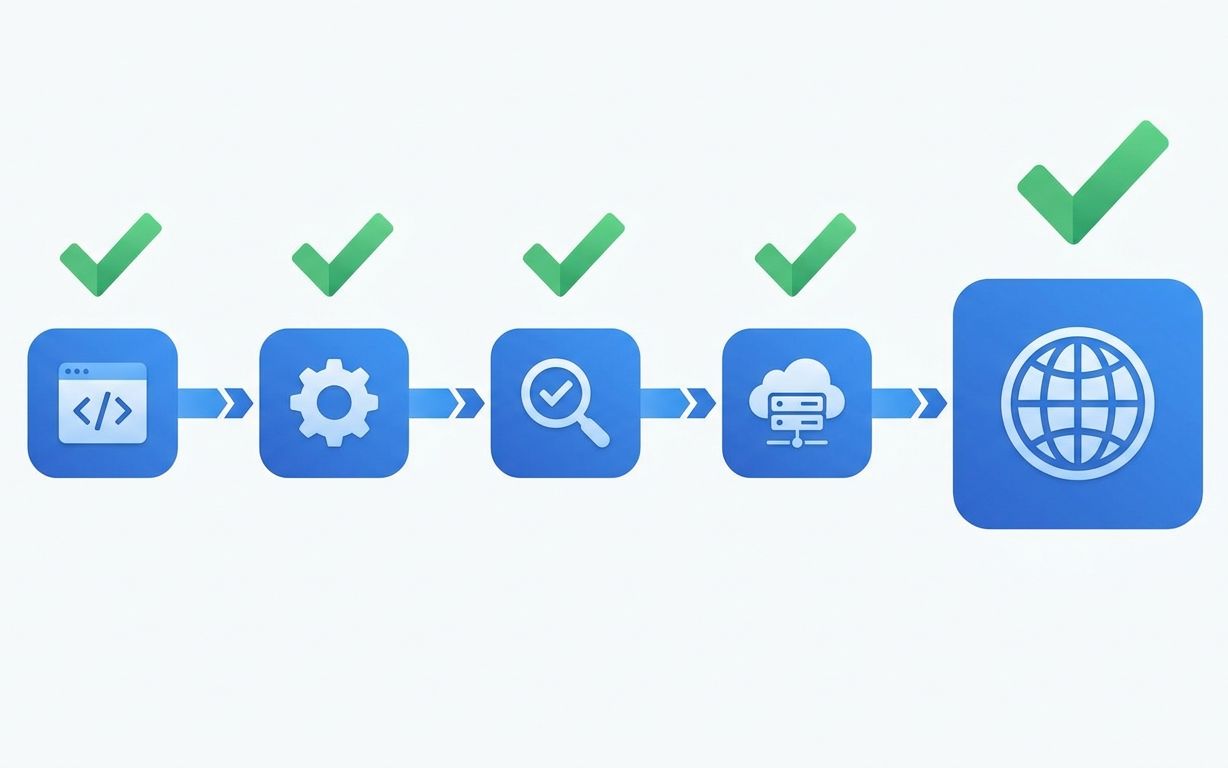
How We Set Up CI/CD for Every Client Project
Every project we ship gets the same CI/CD pipeline. It takes 4 hours to set up and saves 200+ hours over the project lifetime.

SaaS Development for Edtech: Building for Schools and Students
Schools buy software in June, onboard in August, and complain in September. Your edtech product needs to survive all three.